Lyapunov Exploration: Dimensionality, Stability, and the End of "Vibes-Based" AI

1. Physical Foundations: Dimensions as Conversion Operators
Let’s start with the heavy hitters: constants like $c$, $G$, $\hbar$, and $k_B$. We usually think of these as just “numbers in a formula,” but they’re actually conversion operators—the invariant bridges linking length, time, mass, charge, and temperature.
For example:
- $c$ isn’t just the speed of light; it’s the operator relating time to length.
- $G$ ties mass-energy scales to the actual curvature of spacetime.
Their numerical values are arbitrary (depending on your unit system), but their deeper role is to define the “exchange rate” between different fundamental dimensions. If you want to reason consistently across different scales of reality, you need these invariants.
The Hacker Takeaway: In AI, we face a similar problem. How do you relate a “Logic” score to an “Evidence Grounding” score? You need “Stability Weights” that act as the physical constants of your system, defining the invariant bridges between different dimensions of truth.
2. The Manifold Hypothesis: AI’s Hidden Geometry
Why does dimensional reduction actually work? It’s not just a compression hack; it’s the Manifold Hypothesis.
The idea is that high-dimensional data (like the pixels of a face or the tokens in a medical transcript) doesn’t actually fill the entire high-dimensional space. Instead, it sits on a much lower-dimensional manifold—a thin, curved “sheet” of reality embedded in the chaos.
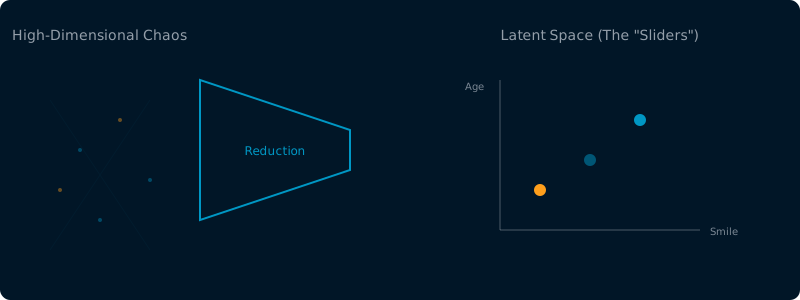
When we train an LLM, we’re essentially trying to learn the coordinates of this manifold. This is your latent space. Instead of tracking 100,000 token probabilities, the system learns the 3,000 meaningful “directions” that define a coherent thought. We lose the microscopic noise, but we keep the geometry.
3. The Problem: Statistical Plausibility vs. Dynamical Stability
Standard LLMs generate text by picking the next token that is most statistically plausible. In control theory terms, this is an “unstable plant.” The model follows the path of least resistance (plausibility) without a feedback loop to keep it anchored to the manifold of truth.
This is where hallucinations come from: the model’s trajectory “drifts” off the manifold into the high-dimensional void where things sound “natural” but are factually impossible.
Stability-Guided Generation
To fix this, we stop asking “what sounds likely?” and start treating generation as a Dynamical System. We want a system where the “true” state is a Global Attractor.
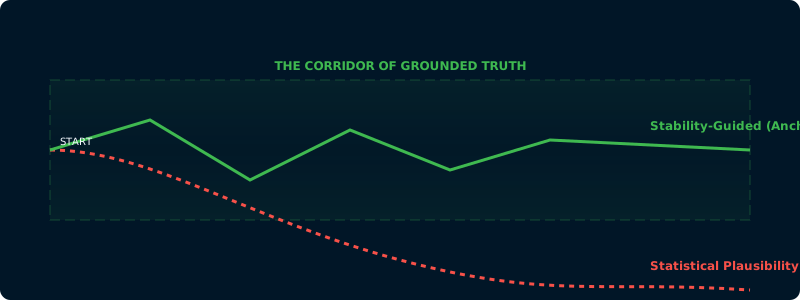
We measure “drift” using concrete signals:
- NLI Cross-Encoders: To detect contradictory entailment between the draft and the source.
- Embeddings Distance: Measuring how far the current hidden state has wandered from the trusted evidence cluster in latent space.
4. Lyapunov Functions: Proving It Finishes
But how do you guarantee the system stays on track? You define a Lyapunov Function $V(s)$.
In mathematics, for a system to be stable, we need a function $V(s)$ that is:
- Positive-Definite: $V(s) > 0$ whenever we aren’t at the goal.
- Negative-Definite Derivative: $\dot{V}(s) < 0$ along every trajectory.
Basically, $V(s)$ measures the “Energy” or “Remaining Work.” If we can prove that every generation step must reduce the total energy, we’ve proven the system must reach the goal.
The Composite Stability Potential
We can define a stability potential $V$ as a function of our coverage state: $$V(s) = \sum_{i=1}^{n} w_i (1 - P_i(doc))$$ (Where $P_i$ is a boolean predicate for property $i$, and $w_i$ are our “Physical Constants”)
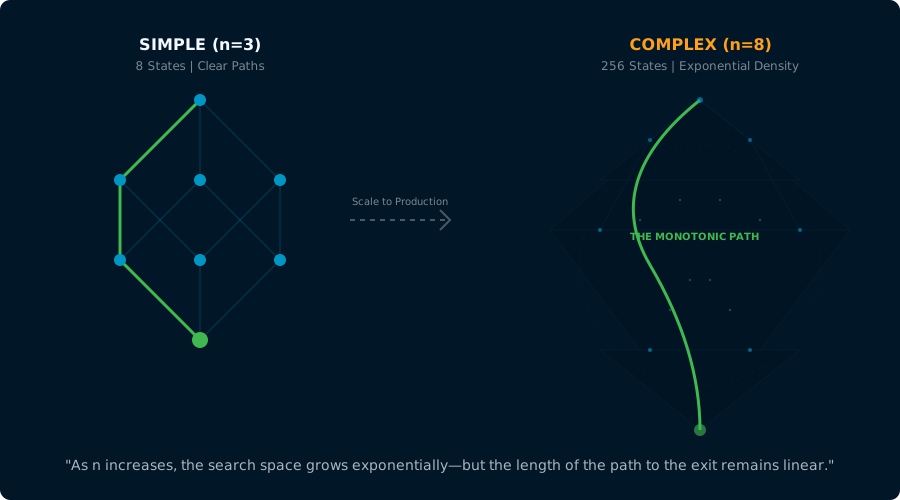
Because our system is designed for Monotonic Accumulation (once a fact is verified, we OR it into the state and never delete it), the “derivative” of our potential function is always negative. Every time we flip a bit from 0 to 1, $V(s)$ drops.
5. Draining the Tub: The Entropy Interpretation
Think of the system’s uncertainty as a bathtub full of water. At the start, the “water level” (Shannon Entropy) is high. Each successful generation step opens a drain.
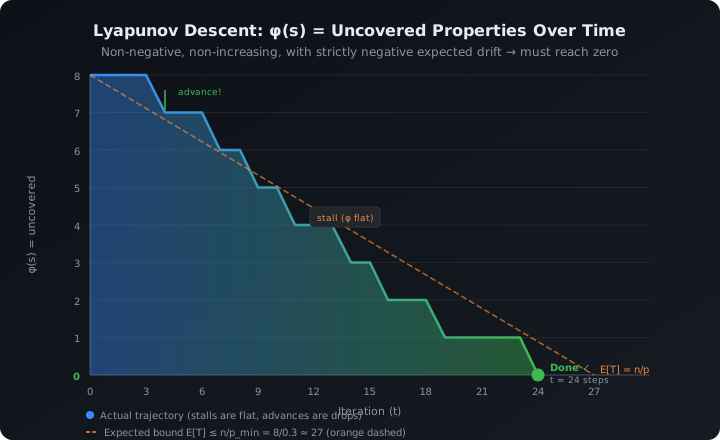
Because progress is monotonic, the water only goes down. As long as our LLM has even a non-zero probability of producing a useful token, the tub must eventually empty. This isn’t a “vibe”; it’s a mathematical upper bound on execution time.
Conclusion: Killing the Vibes
The future of reliable AI isn’t just “bigger models.” It’s wrapping stochastic engines in deterministic frames. By using the Manifold Hypothesis to understand where we are, and Lyapunov Functions to prove where we’re going, we can move beyond “vibes-based” AI and start building systems that are provably, mathematically stable.
Published on
Tags: ai, llm, mathematics, stability, lyapunov, latent-space